
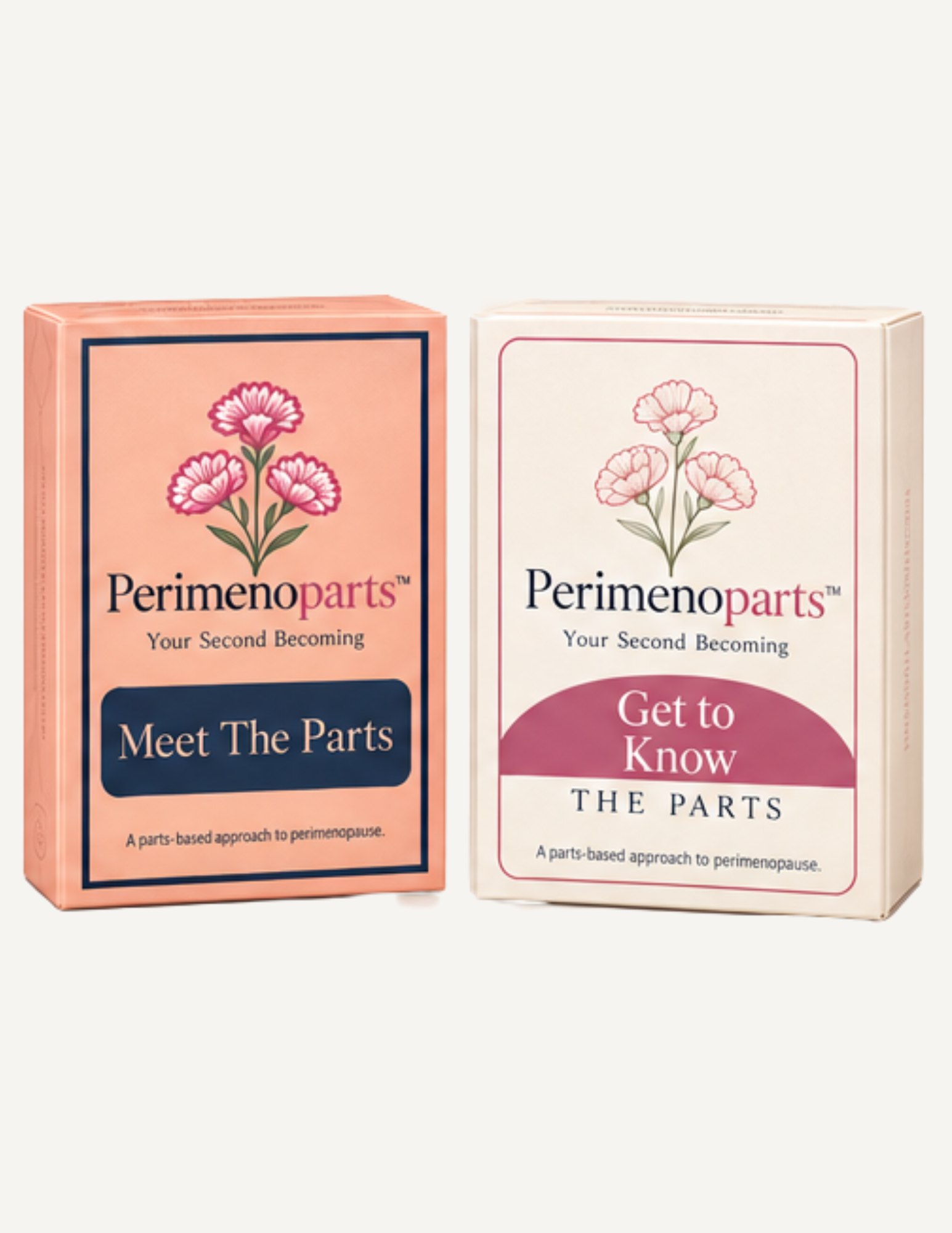
PerimenoParts Cards are now available!
~
$50 per deck or $90 for both
PerimenoParts Cards are now available! ~ $50 per deck or $90 for both
PerimenoParts™
Curiosity opens the conversation.
Compassion lets it unfold.
Card decks to help you name what you’ve been experiencing and explore the parts of you responding to it.

When there is more happening than you know how to explain
〰️
When there is more happening than you know how to explain 〰️
You may be trying to understand a body that feels unfamiliar while still being the person everyone counts on.
A Part of you wants answers.
A Part of you wants rest.
Another Part is already making a list of everything you should be doing differently.
PerimenoParts™ offers a place to pause. With relatable language, education, reflection, and a little humor, these decks invite you to notice what is happening and get curious about what you need.
One card. One conversation. Room to listen to yourself.
Get Started with the PerimenoParts™ Collection.
NOW AVAILABLE!
A little language for a body doing a lot.
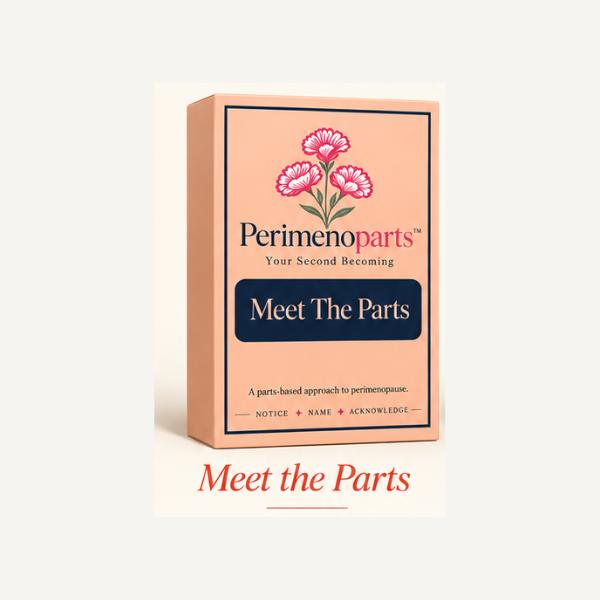
When your body feels unfamiliar, it can be hard to know where to begin. Meet the Parts offers a compassionate introduction to the physical experiences that may accompany perimenopause—with relatable illustrations, accessible education, and humor that makes room for the absurdity of it all.
This first card deck in the PerimenoParts series helps you notice what is happening, find words for your experience, and bring more focused questions to your healthcare conversations.
Inside the 48+ card deck, you will find-
● Illustrated cards introducing a range of perimenopause-related experiences.
● Educational explanations of what may be happening and why.
● Common experiences to notice and questions to discuss with a healthcare provider.
● A welcoming introduction to the PerimenoParts approach.
This may be your starting point if…
You want to better describe what you’re noticing in your body. You appreciate information that feels approachable and human. Or you would like a tangible way to begin a conversation about experiences you have struggled to explain.
How to use it
Choose a card that connects with your experience. Read it, note what feels relevant, and jot down questions or patterns you want to discuss with your healthcare provider. You do not need to identify with every card.
Find more ways to use the deck in the card deck introduction, as well as on the PerimenoParts webpage.
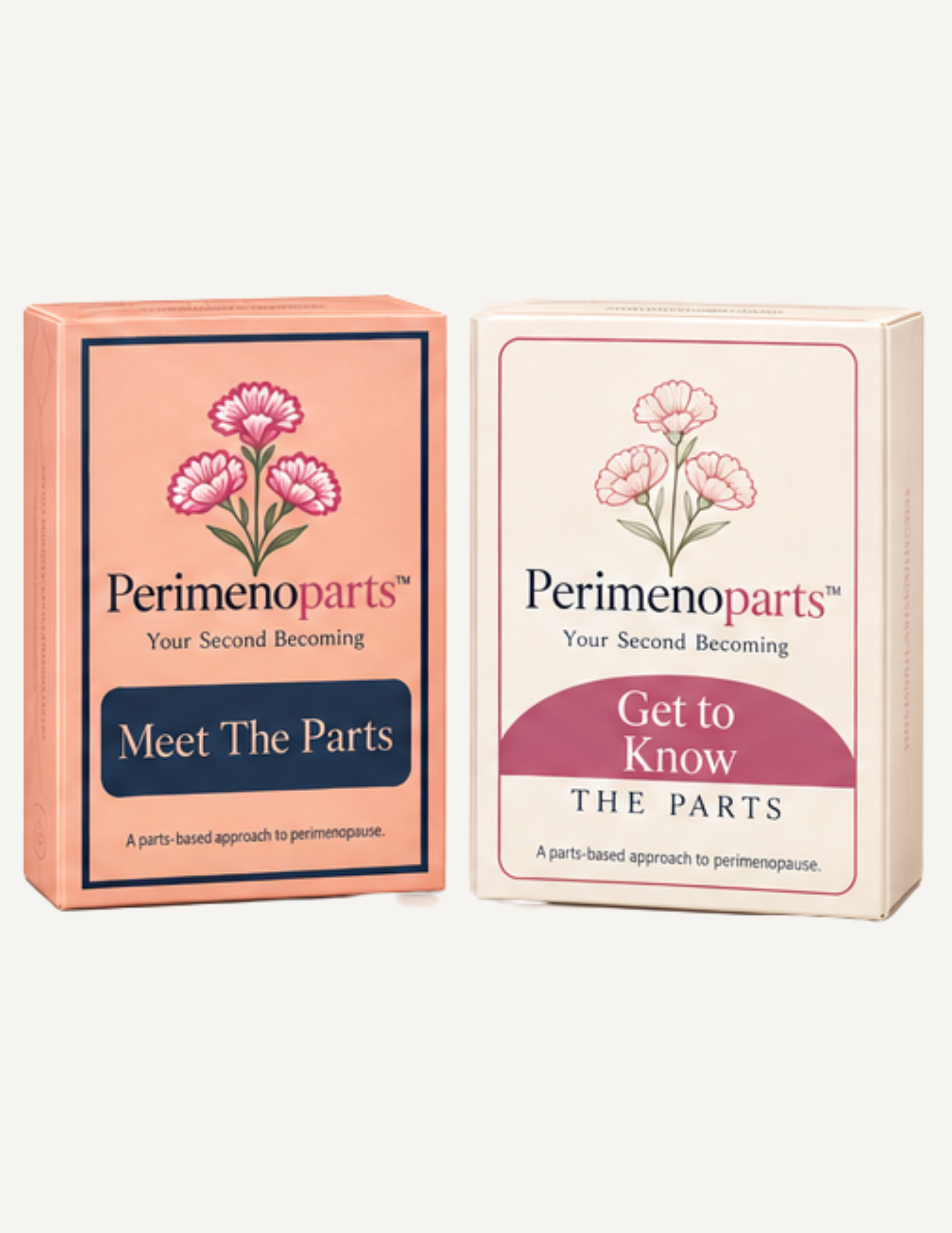
Meet the Parts
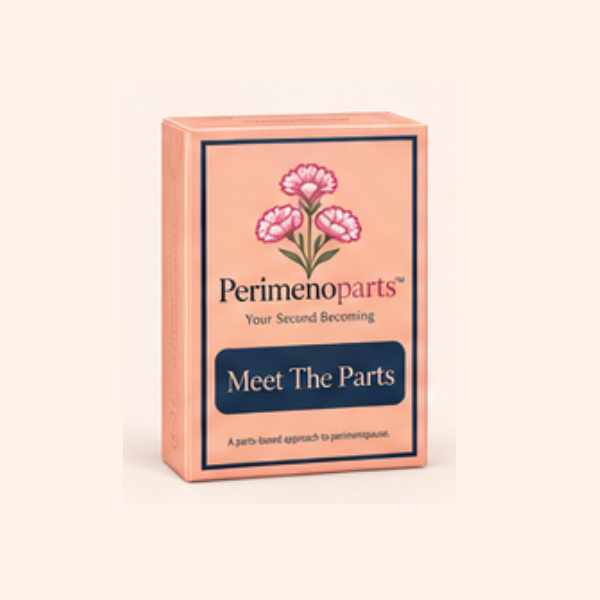
A relatable introduction to the physical experiences of perimenopause, with symptom education, gentle humor, and language for your next healthcare conversation.
Get to Know the Parts
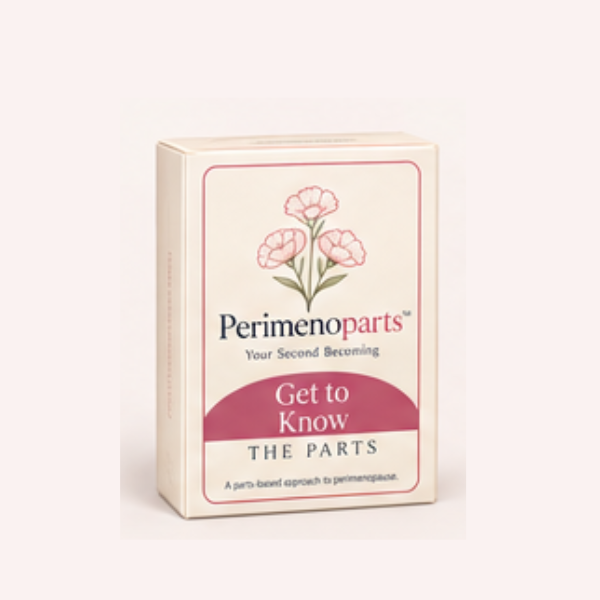
Reflect on the feelings, needs, and protective patterns that may be showing up in perimenopause—with questions that invite curiosity and self-compassion.

Explore the feelings, needs, and protective patterns showing up in perimenopause with the PerimenoParts Get to Know the Parts card deck.
A little room for the parts carrying a lot.
Part of you keeps pushing. Part of you is exhausted. Part of you wonders why things that once felt manageable now ask so much of you.
In this second deck of the PerimenoParts series, Get to Know the Parts invites you to slow down and listen to these inner responses. This deck offers questions and prompts to explore the feelings, needs, and protective patterns that may be showing up during perimenopause.
There is no correct response to uncover. You get to decide which words fit, what feels useful, and how deeply you want to explore.
Inside this 50+ card deck, you will find-
● Named parts that offer possible starting points for reflection.
● Questions and brief prompts for exploring feelings, needs, and patterns.
● Invitations to consider what a part may want you to know or may be trying to protect.
● Guidance informed by the qualities of curiosity, compassion, and connection.
This may be your starting point if…
You recognize familiar patterns such as pushing through, people-pleasing, withdrawing, or trying to control everything—and want space to understand them. You may also be looking for a gentle way to begin journaling or bring something meaningful into therapy.
How to use it
Choose a card that catches your attention. Notice what fits and what does not. Consider one question, write a few words, or simply sit with your response. You can rename the part, set the card aside, or explore it with a therapist.
What’s included: One Get to Know the Parts physical card deck.
The series does have a progression, however, you do not have to follow any prescribed order. Begin with the deck that feels most relevant to you.
Not sure which deck to get? Grab both and get a discount!
Understand what’s happening. Explore how it’s affecting you.
The PerimenoParts™ two-deck bundle pairs symptom education with personal reflection, helping you connect what you’re noticing in your body with the feelings, needs, and inner responses showing up alongside it. Together, the decks give you more language for your experience and a starting point for understanding what support you need.
Includes: Meet the Parts + Get to Know the Parts card sets.
The Series Is Growing!
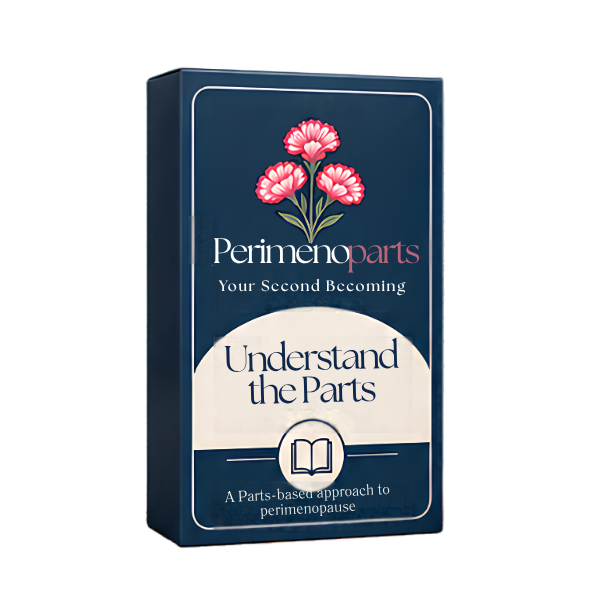
Coming Soon!
understand the parts
Deepen your understanding of your inner parts—their fears, needs, and what they may be trying to protect. Explore how they relate to one another and to your experience of perimenopause.
Navy edition
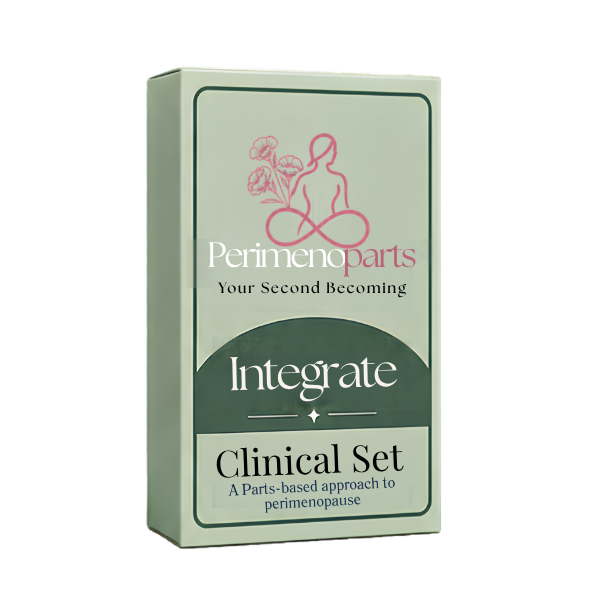
Coming Soon!
Integrate · Clinician set
Bring parts-based exploration into your work with clients navigating perimenopause. A companion for clinicians to connect reflection, body awareness, and compassionate curiosity within the therapeutic process.
Green edition
More details will be shared as these editions take shape.
Ways To Use These Cards
One deck. Many different ways to begin.
Thoughtfully crafted to elevate what matters most.
You don’t need a quiet house, a fresh journal, or an hour to yourself. Begin with one card and a little curiosity. Choose the approach that meets you where you are today.
-
Choose a card that catches your attention. Notice what feels familiar, what doesn’t fit, and what comes up as you read.
Ask yourself: What am I noticing? What might I need? What is one small way I could respond?
A few moments count. You can leave it there.
-
When “I just don’t feel like myself” is the closest you can get, start with Meet the Parts. Look for a card that resembles something you’ve been noticing in your body.
Use it as a starting point to describe your experience in your own words: For me, it feels like…
You don’t have to relate to everything on the card for some of it to be useful.
-
Reach for Get to Know the Parts when you notice yourself pushing through, pulling away, pleasing everyone, or trying to keep everything under control.
Choose a card that resonates and gently wonder: What might this part want me to understand? What is it concerned about? What would feel supportive right now?
Let your own experience guide the exploration. The card’s name is an invitation, not a label you have to accept.
-
Choose one question from a card and write whatever comes. A sentence, a list, or a few scattered words are enough.
You might begin with:
● “A part of me feels…”
● “What I wish someone understood is…”
● “What I need more room for is…”
You can draw, record a voice note, or simply reflect instead.
-
Set aside a card that captures something you want to explore with your therapist.
You might say: “This feels familiar, but I’m not sure why,” or “This says something I’ve had trouble putting into words.”
Together, you can decide whether and how the card fits your work.
-
Use Meet the Parts to help organize questions about experiences you’ve been noticing. Alongside the card, write down when they began, how often they happen, and how they affect your daily life.
Bring your notes to your appointment. The cards can start a conversation; they cannot determine whether a symptom is caused by perimenopause.
-
Choose a card to share with a partner, friend, or trusted person.
Try: “This describes some of what I’ve been experiencing. Would you be willing to listen while I explain what it’s like for me?”
You can also name the support you want: listening, practical help, company, or space.
-
Start with a Meet the Parts card that reflects a physical experience. Then explore Get to Know the Parts for an inner response that feels familiar.
Ask: When this happens in my body, what feelings or responses show up? What needs my attention?
There is no required pairing. You may notice several responses—or none that match the cards.
-
Return to a card after a few days or weeks. Does it land differently? Is the same need still present? Has something else become more important?
Keep a brief note if that feels useful. This is an invitation to notice, without turning reflection into another task to keep up with.
-
Invite participants to choose a card and reflect privately before offering an opportunity to share.
Prompts might include: “What resonates?” “What would you rename?” or “What would you like more support with?”
Sharing is always optional. Participants can pass, choose a different card, or keep their reflections to themselves.
-
Therapists, healthcare providers, coaches, nutrition specialists, support-group facilitators, and wellness educators can use PerimenoParts™ to open conversations about perimenopause and invite people to describe their experiences in their own words.
In therapy: Invite a client to choose a card that resonates. Explore the emotions, needs, or protective responses they identify, using the card as a starting point within your therapeutic approach.
In healthcare visits: Use Meet the Parts to support symptom conversations and help patients articulate what they’re noticing, how it affects daily life, and what questions they want to ask.
In groups, workshops, or retreats: Offer a card as a prompt for education, private reflection, journaling, or optional discussion. Allow participants to pass or choose a different card.
In professional education: Use selected cards to introduce discussion about the physical and emotional experiences of perimenopause and how professionals can respond with curiosity and compassion.
Try asking: “What fits your experience? What would you change? What would you like me to understand?”
Use the cards within your training and professional scope. They are conversation and reflection tools—not diagnostic assessments or a substitute for clinical judgment or IFS training. A card does not define someone’s internal system or establish the cause of a physical symptom.
-
Rename a part. Skip a question. Put the cards down. These decks offer possibilities to explore, and you decide what fits and how far you want to go.
Looking for more guidance or support around perimenopause?
Reach out to let me know how I can help!
Cards created by Dawn Leprich-Graves

I created PerimenoParts to give women more language for what they are experiencing—and more room to meet themselves with curiosity and compassion.
My work brings together reproductive mental health, Internal Family Systems (IFS), Brainspotting and somatic-based approaches. These cards offer a tangible starting point for noticing the body’s changes and exploring the inner responses that may accompany them.
Dawn Leprich-Graves, LCPC, LPC, PMH-C, ASDCS IFS Level 1 Trained · Certified Brainspotting Therapist · Creator of PerimenoParts™

Questions You May Be Pondering-
-
Each deck offers a different starting point.
Meet the Parts focuses on symptom education and noticing your body’s experiences.
Get to Know the Parts focuses on emotional responses, needs, and patterns.
Choose one or explore them together.
-
“Parts” is a way of describing different aspects of your inner experience:
the part of us that pushes through,
the part of us that worries,
the part that wants to be left alone.
This language is informed by the therapeutic model of Internal Family Systems (IFS).
A card offers a possibility to explore; it does not define your internal system.
You may relate to some of the Parts, but not others. You may want to rename a part, decide it does not fit, or discover something entirely different.
You may find your Parts want you to be aware of things that are very different than what may be on the cards. The goal is for you to be aware of your inner dialogue.
-
No prior knowledge is needed to begin exploring and reflecting! These cards are actually a great introduction to IFS. Start with the cards that resonate and use your own words.
The decks are validation and an introduction to exploration, rather than a complete IFS course or therapy process.
-
Many of the physical experiences featured in these cards are common symptoms of perimenopause. They are real and deserve to be taken seriously. Parts language helps us explore how we respond to those experiences; it does not mean an emotional part has caused the symptom or that it is “all in your head.”
The cards cannot determine what is causing an individual symptom. Because symptoms can have more than one cause, new, persistent, or concerning changes deserve appropriate medical evaluation.
Validating what is showing up in our bodies and how we respond is just the start of connecting to our inner systems.
-
No. PerimenoParts decks are educational and reflective resources. They do not diagnose, treat, or replace individualized medical or mental health care. Using or purchasing a deck does not establish a therapeutic relationship. If anything, these cards may act as catalysts to you seeking medical and therapeutic support from licensed professionals.
-
Yes! You can bring the cards that capture something you have found difficult to explain, thought or emotionally provoking or as a reference, and ask your therapist/doctor whether it would be useful to explore together.